
AI customer experience: where an agent helps and where it hurts | RibboAI

An AI agent can make support faster and more consistent, or trap customers in loops and give wrong answers with confidence. The failure modes, the design choice that prevents each one, and what to measure.
Where an AI agent improves the customer experience
- Answers outside opening hours. The delivery question at 10 pm gets answered at 10 pm, not at 9 the next morning after the customer has given up.
- The same answer every time. Two staff members can give two versions of the returns policy. An agent answering from one source gives one.
- The customer's own language. A customer who writes in Portuguese gets a reply in Portuguese, from a knowledge base written once.
- No hold queue for simple things. Opening hours, delivery areas and order status do not need to wait behind a complaint.
- Better handoffs. A good agent gathers the order number and the problem before a person joins, so the person starts with the answer instead of the questions.
- A record of every conversation. Every thread is kept and readable, which shows you what customers actually ask instead of what you assume they ask.
Where it hurts, and why
The damage follows a few patterns, and each one has been documented outside vendor marketing:
The loop with no exit
The US Consumer Financial Protection Bureau studied chatbots in banking and found that over 98 million people, about 37% of the US population, used a bank's chatbot in 2022. Its 2023 report describes customers caught in "continuous loops of repetitive, unhelpful jargon or legalese without an offramp to a human customer service representative". It also warned that scripted bots may only recognize a dispute if the customer uses specific words.
A loop is a design decision: someone chose not to offer a person or set the bar for handoff too high.
The confident wrong answer
In 2024 a Canadian tribunal held Air Canada responsible for a refund rule its website chatbot described but the airline did not offer, and ordered it to pay the difference, as CBC News reported. To the customer, the chatbot's answer was the company's answer. That is the standard every customer applies.
Starting again with a person
The customer explains the problem to the bot, gets transferred, and the person asks them to explain it again. The bot made the experience longer than no bot at all.
The bot that pretends
Customers forgive a bot that says it is a bot. They are much less forgiving when they find out halfway through. Some channels require disclosure anyway: Meta's Messenger rules, covered in our Messenger chatbot guide, are one example.
Automating the wrong moments
A bereavement, a fraud report or a complaint about a previous complaint is not the place for a cheerful FAQ answer. Some conversations should reach a person on the first message.
How to improve customer service with an AI agent
Each fix below maps to one of the failures above.
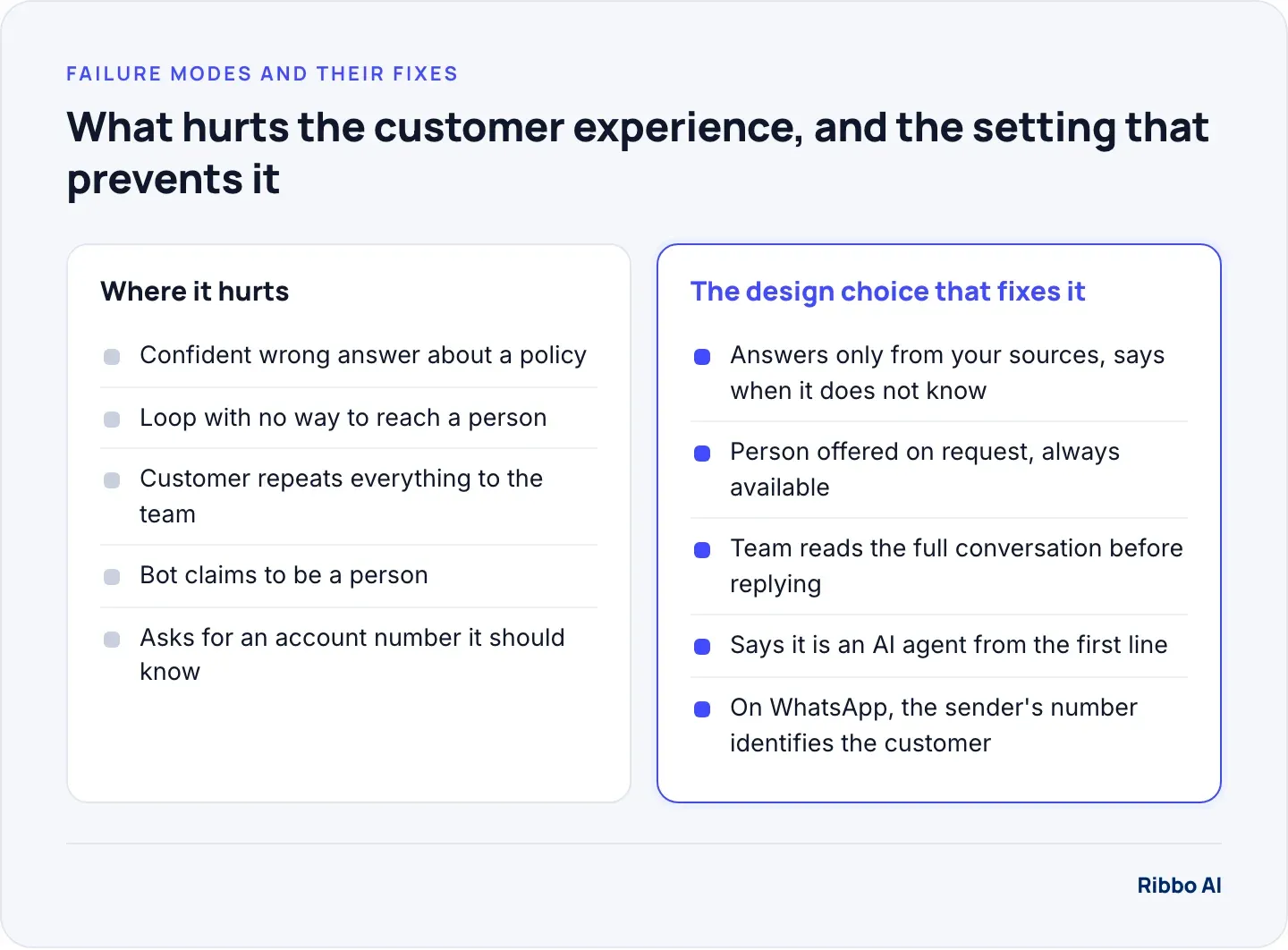
- Limit answers to your own sources. The agent answers from your pages and policies and nothing else and says "I don't know" when the sources do not cover it. Our glossary entry on guardrails covers the rules worth setting.
- Make a person always reachable. "Talk to a person" works at any point, in any wording. Set further triggers: complaints, refunds, repeat contacts, and any case where the agent is unsure.
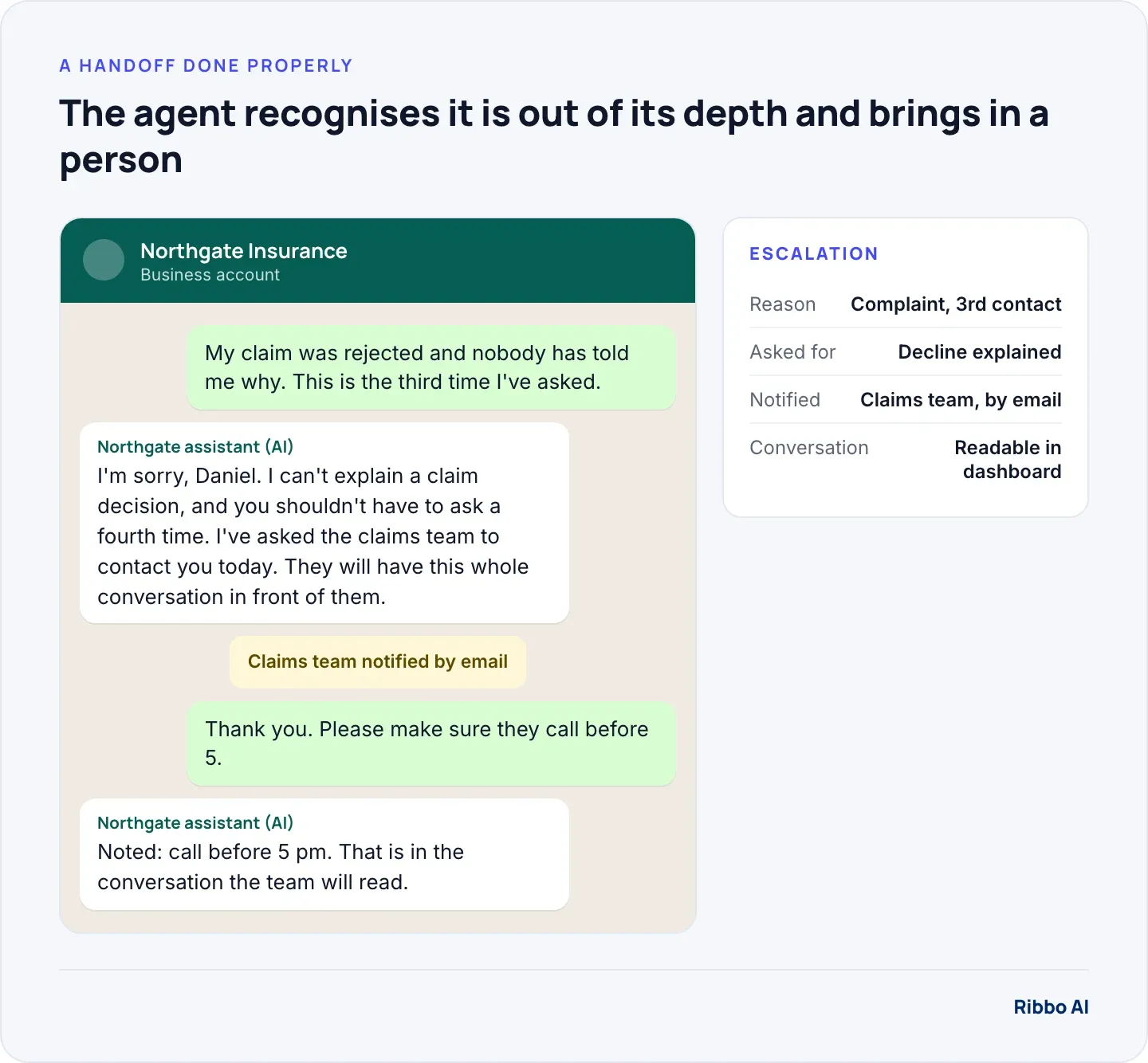
- Hand over with context. The person who follows up reads the whole conversation before replying, so nobody asks the customer twice. See human handoff for the mechanics.
- Say what it is. Name it as an AI agent in the first message.
- Know who is writing. On WhatsApp the sender's phone number identifies the customer, so the agent can look up their order without asking for a reference they do not have to hand.
What to measure
A single number like "percentage of chats handled by AI" hides the damage, because a customer who gives up in a loop counts as handled. Watch these together:
- Resolution split. Resolved by the agent, resolved by the team, still open. A high agent share of resolved inquiries with falling satisfaction is a warning.
- Repeat contacts. Customers who come back within a few days about the same issue were not helped the first time.
- Handoff reasons. Which topics go to people, and whether they should have.
- Satisfaction on agent-only conversations compared with human ones. Our CSAT calculator and customer effort score calculator help you set a baseline before launch.
- Unanswered questions. The list of things it could not answer is your next content work.
Where Ribbo fits
Ribbo AI covers several of the fixes above. Its agents answer only from the website, documents and files you give them, and are instructed to say when they do not know. With escalation switched on, the agent offers a person when the customer asks or after a set number of questions, and your team gets an email and follows up. Every conversation is readable in the Ribbo dashboard, which is where the weekly transcript reading happens. On WhatsApp, the sender's number lets a Data Tool look up the customer's order from the first message. The platform page shows how knowledge, Data Tools and escalation work together, and our post on building a knowledge base chatbot covers the content side.
Frequently asked questions
Do customers prefer talking to AI or to people?
It depends on the job. For a quick fact at an odd hour, most people want the fastest correct answer. For a complaint or a complicated problem, they want a person. Design for both instead of choosing one.
How do I stop an AI agent from frustrating customers?
Keep a person reachable at every point, make sure whoever follows up has read the conversation, and restrict answers to your own sources. Then read transcripts weekly and move the handoff line based on what you see.
Which questions should never go to an AI agent?
Fraud reports, bereavements, legal threats, formal complaints and anything where a mistake cannot be undone. Route these to a person on the first message, with the agent only collecting the basics.
How soon will I see an improvement?
Speed and out-of-hours coverage improve on day one. Answer quality improves over the first weeks as you fix content gaps the agent reveals. Measure satisfaction before launch so you can compare.