
AI Agent Consulting: What a Good Engagement Looks Like | RibboAI

A good AI agent consulting engagement ends with an agent in production, a measured result and a set of artefacts your team owns. Here is what each phase should produce and what to ask for in the contract.
AI agent consulting is paid help to take one AI agent from an idea to production: choosing the use case, connecting it to your systems, testing it on real questions and putting it live with rules your risk team has signed off. A good engagement ends with three things in your hands: an agent answering real customers, a measured result against a baseline, and every artefact needed to run it without the consultants.
Most of what goes wrong in these projects is visible in the proposal before anyone writes a line of configuration. This guide sets out what each phase should produce, what you should own at the end, and the questions that separate a delivery partner from a strategy deck.
AI agent consulting versus general AI consulting
General AI consulting usually starts wide: an opportunity assessment across the business, a maturity model, a roadmap with twenty use cases. That work has a place when a board needs a view of where AI could matter. It rarely puts anything in front of a customer.
AI agent consulting starts narrow. It picks one job that customers or staff already ask for every day, such as "what is my policy renewal date" or "where is my order", and builds an agent that does that job end to end. The deliverable is working software in production, with a number that shows whether it helped.
The test for which kind you are buying is simple. Ask what will be running on the last day of the engagement. If the answer is a document, it is general consulting. If the answer is an agent on a named channel, handling a named set of questions, it is agent consulting.
The four phases of a good engagement
Engagements vary in length, but the sound ones share a shape. Each phase has a written output, and the next phase does not start until that output exists.
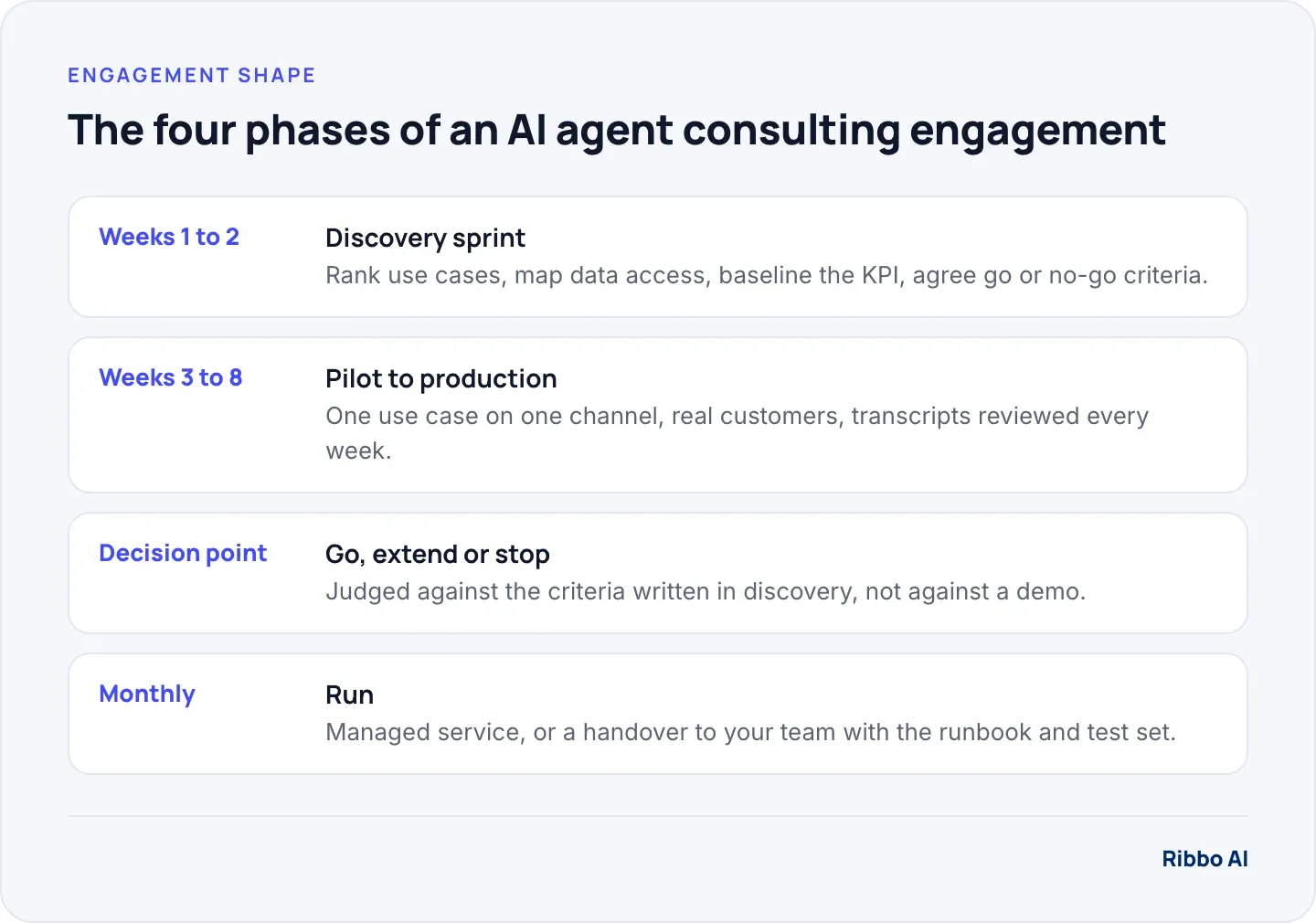
1. Discovery sprint
Two weeks is enough for a single business line. By the end, you should have:
- A ranked list of use cases, scored on volume, risk and the data each one needs. The top one becomes the pilot.
- A data access map. For the chosen use case: which system holds the answer, whether it has an API, who owns it, and how the customer will be verified before any lookup.
- A baseline. The current figure for the KPI the pilot will move, measured before anything changes. Response time, contacts per order, cost per contact or first contact resolution are typical.
- Go or no-go criteria, written down and agreed by the business owner and risk before the pilot starts.
- A risk register for the use case: what the agent must never say, which actions need a person's approval, and which topics always go to a person.
A discovery fee that is credited against the pilot is a good sign. It means the partner expects discovery to lead somewhere, and it gives you a clean exit if it does not.
2. Pilot to production
The pilot runs on one channel with real customers, usually for four to six weeks. Real customers matter because test questions written by staff are cleaner than what customers actually type. During the pilot the partner should run a weekly transcript review with your team: read a sample of conversations, label what went wrong, fix the content or the rules, and record the change.
By the end of the pilot, you should have a test set built from real customer questions, run before every change, and a log of every fix made and why.
3. The decision
The pilot ends with a decision against the criteria from discovery: go to full production, extend with a specific change, or stop. Stopping is a legitimate outcome. A partner who cannot describe what failure would look like has not defined success either.
4. Run
After go-live there are two sensible paths. A managed service, where the partner keeps reviewing transcripts, updating content and adding use cases for a monthly fee. Or a handover, where your team takes over with the runbook and test set. Many enterprises do the first for six to twelve months and then move to the second.
What you should own at the end
This is the part of AI consulting contracts that gets the least attention and causes the most pain later. If the consultant built the agent in their own account, under their own credentials, with instructions you have never read, you cannot change supplier, audit a complaint or answer a regulator without them.
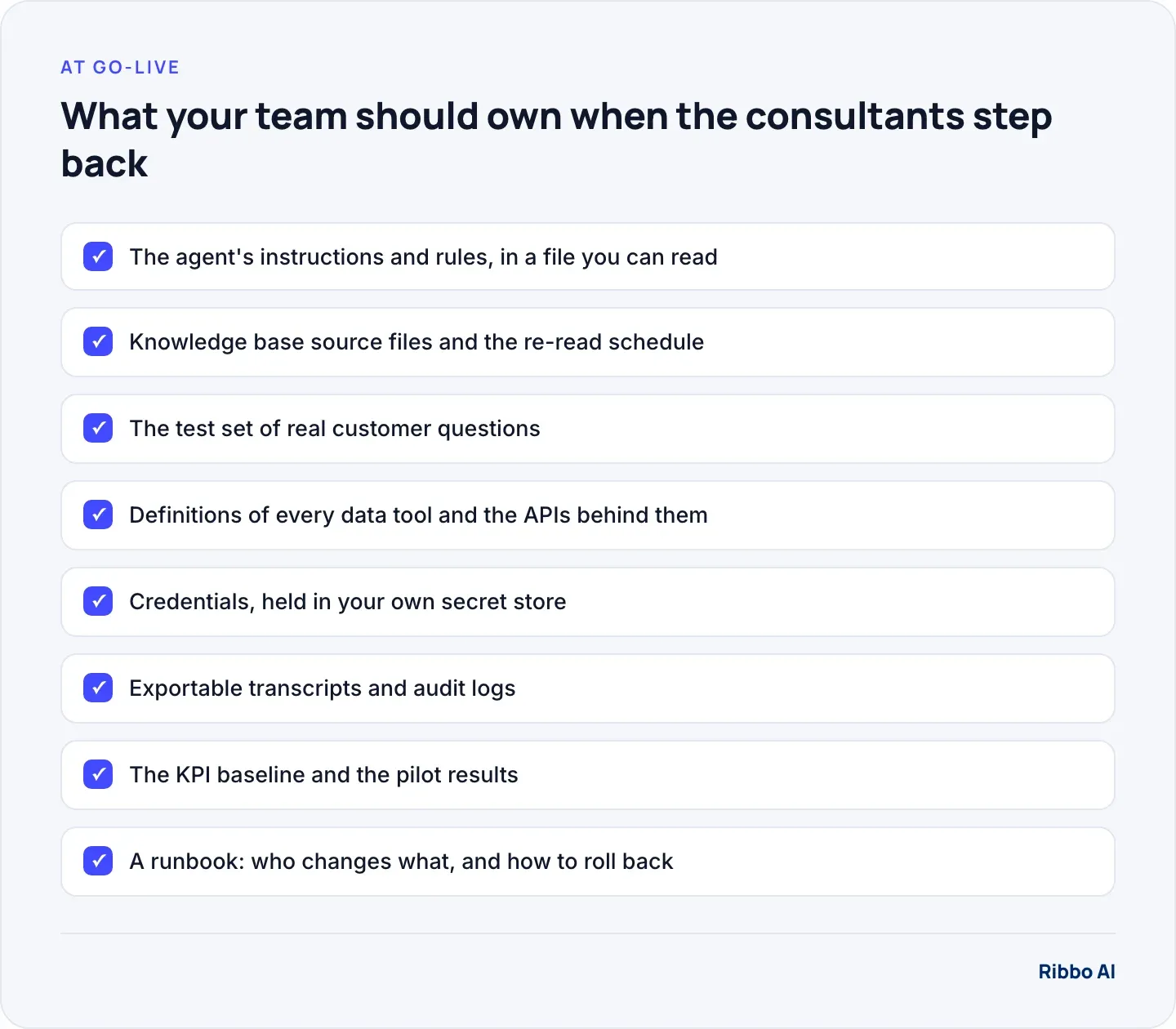
Put this list in the statement of work. Two items deserve extra care.
Credentials. API keys for your core systems should sit in a secret store you control, scoped to the single tool that needs them. Nobody should be pasting a production key into a configuration screen they will lose access to.
The test set. A few hundred real questions with the expected answer or action for each is the most valuable artefact of the whole engagement. It lets you change model, change prompt or change supplier and know within an hour whether quality held.
Red flags in an AI agent consulting proposal
- No baseline. If nothing is measured before the pilot, any result can be presented as a success.
- Many use cases at once. A pilot covering billing, claims, sales and complaints together will produce a demo, not a decision.
- Demo questions instead of real ones. Ask where the test questions come from. The answer should be your own inbox, chat logs and WhatsApp threads.
- No handoff design. The proposal should say when the agent hands over, to which queue, and what the person receiving it sees. See our glossary entry on human handoff.
- Identity left to the model. Any agent that reads customer records must verify the customer and bind their identifier on the server, so a cleverly worded message cannot request someone else's account.
- Vague ownership. If the proposal does not say who owns the account, the content and the data at the end, assume it is not you.
Questions to ask before you sign
- What will be live on the last day, on which channel, for which questions?
- Which KPI will you baseline, and how will you measure it?
- Who is our named contact from first call to production, and are they the person doing the build?
- How do you verify customers before a lookup, and where does the identifier come from?
- Which actions will wait for a person's approval?
- Can we export transcripts and audit logs at any time, in a format our own tools can read?
- What happens to the agent, the content and the credentials if we end the contract?
Regulation is a fair topic to raise too. The European Commission's summary of the AI Act says people using AI systems such as chatbots should be made aware that they are talking to a machine, and that the transparency rules came into effect in August 2026. A partner working with European customers should build that disclosure into the first message without being asked. For governance more broadly, the voluntary NIST AI Risk Management Framework organizes the work into four functions (govern, map, measure, manage), which is a useful checklist for what the engagement leaves behind.
How AI agent consulting is usually priced
Three pricing structures are common, and each fits a different phase.
- Fixed fee for discovery. The scope is bounded, so the price should be too.
- Fixed or capped fee for the pilot, tied to the outputs listed above rather than to hours.
- Monthly fee for the run phase, scaled to volume, channels and the number of use cases.
Be wary of open-ended time and materials for a pilot. It rewards a longer pilot, which is the opposite of what you want. Separately, check that platform costs (model usage, messaging fees from the channel, software licenses) are listed apart from the consulting fee, so you can see what continues after the consultants leave. Our enterprise page sets out how Ribbo separates the implementation fee from the monthly platform fee.
Where Ribbo fits
Ribbo AI's enterprise service starts from the same premise: Ribbo sets up a working agent with your team rather than handing over a builder to learn. The setup covers the sources the agent answers from, the Data Tools that look up exact records through your own APIs, the tone, and the escalation rules that decide when your team gets an email to follow up. Every conversation stays readable in the Ribbo dashboard.
Implementation starts from 1,000 USD, followed by a monthly platform fee. The account belongs to your organization, with team members and roles; when a partner builds the agent, ownership is transferred to you at go-live. Conversations and content are not used to train shared models, and Ribbo answers security questionnaires on request. Put the questions above to Ribbo as you would to any partner and ask for the scope and measures in writing.
Frequently asked questions
How long does an AI agent consulting engagement take?
For a single use case on one channel, expect about two weeks of discovery and four to six weeks of pilot before a go or no-go decision. Additional use cases take less time once the first one has set up verification, handoff and the test process. Anything much longer for a first use case usually means the scope is too wide.
Do we need a data science team to work with an AI agent consultant?
No. You need a business owner for the use case, someone who can grant access to the system that holds the answer, and a person from risk or compliance who can sign off the rules. Model training is rarely part of a customer service agent project, because the agent answers from your content and systems.
Should we build the agent ourselves instead?
If you have engineers who can own model changes, evaluation, channel integrations and security reviews for years, building is reasonable. Most teams underestimate the run phase: transcript review, content updates and testing every release. A partner that hands over the test set and runbook lets you start with help and bring the work in-house later.
What KPI should the pilot target?
Pick the one the business owner already reports on. For service teams that is often first contact resolution, response time or cost per contact. For sales-led use cases, leads captured and their conversion. One primary KPI is enough; track others as context.