
Customer feedback surveys: how to design one people finish | RibboAI

When to send a customer feedback survey, how short to make it, which channel to use, how to read your response rate, and how to turn answers into fixes. With three templates to copy, including a post-chat survey.
A customer feedback survey people finish is short, arrives at the moment it asks about, uses the channel the customer was already in, and asks about one thing. Most surveys that go unanswered break one of those four rules: twelve questions, sent by email a week later, about "your experience with us".
This guide covers each decision in order: what the survey is for, when to send it, how long to make it, which channel, how to read the response rate, and what to do with the answers. It ends with three templates you can copy, including a post-chat survey, and a link to our free NPS calculator for scoring the relationship survey.
Start with the decision the survey will inform
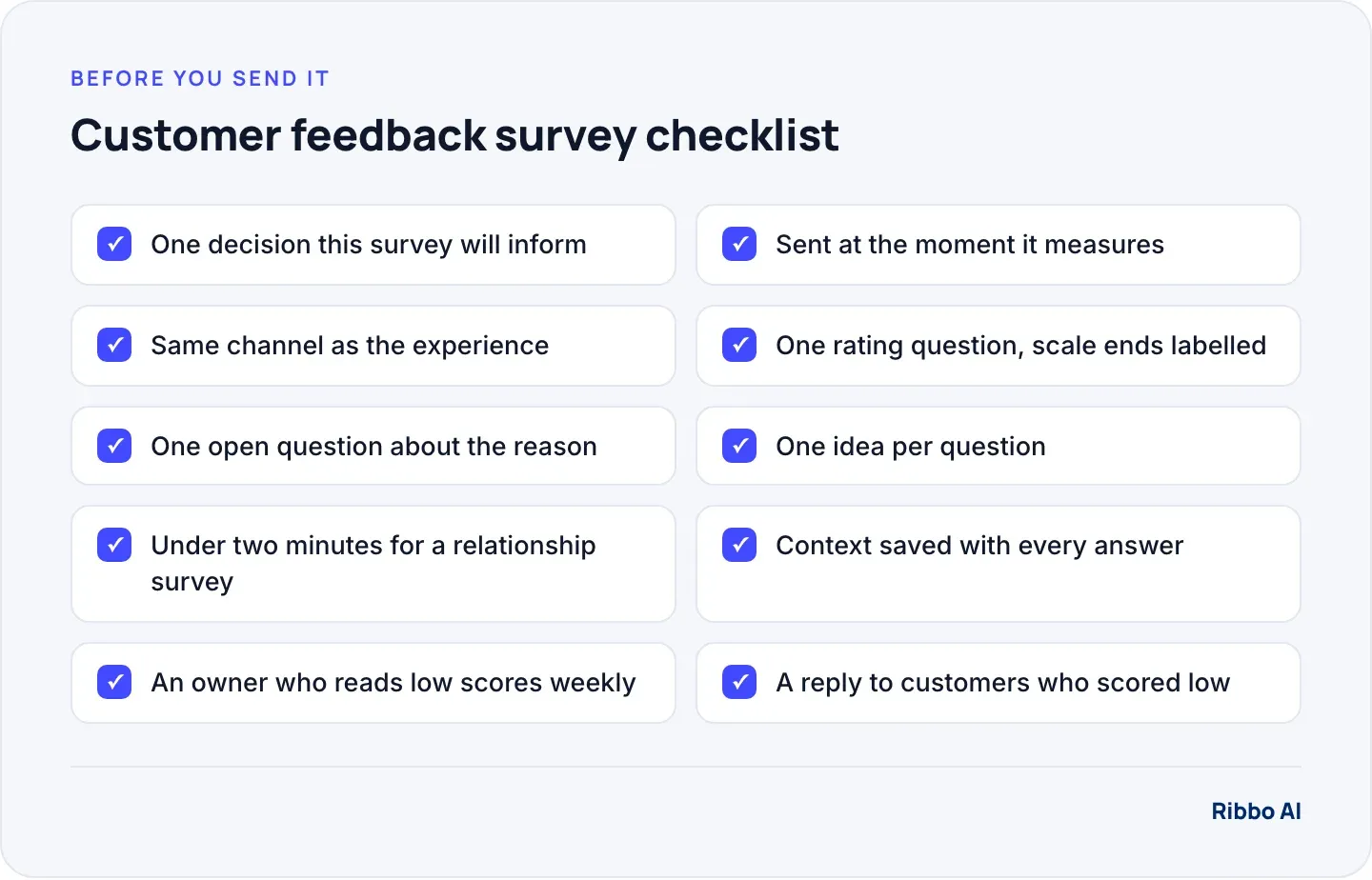
Write one sentence before you write any question: "We will use the answers to decide ___." If you cannot fill the gap, the survey will produce a number that gets reported and ignored.
The decision tells you which measure to use:
| Decision | Measure | Scale |
|---|---|---|
| Is our support helping? | CSAT | 1 to 5 |
| Is this process too hard? | CES | 1 to 7 |
| Is the relationship healthy? | NPS | 0 to 10 |
| Why are customers leaving? | Exit reason | Multiple choice |
CSAT asks how satisfied the customer was with one interaction. Customer effort score asks how easy it was to get something done; Dixon, Freeman and Toman made the case for measuring effort in Harvard Business Review in 2010. NPS asks how likely the customer is to recommend you, worded by Bain as "How likely are you to recommend us to a friend or colleague?" on the Net Promoter System site. Pick one per survey. Combining all three in one form is how a two-question survey becomes twelve.
When to send a customer feedback survey
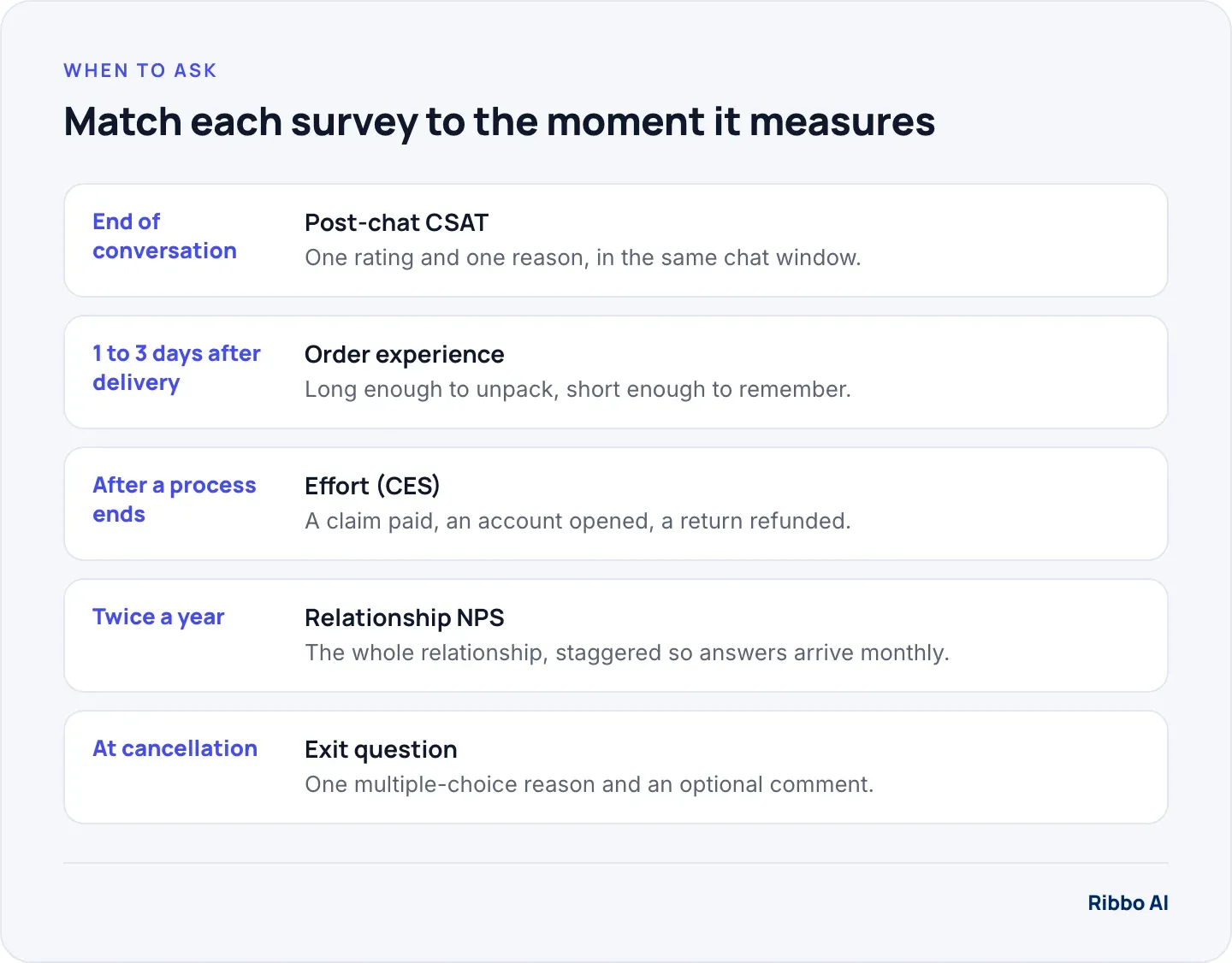
Ask as close to the experience as possible, but after the outcome is known. A post-chat survey goes at the end of the chat. A delivery survey goes after the parcel arrives, not when it ships. An effort survey goes when the claim is paid or the refund lands.
Two timing rules save most surveys:
- Do not survey the same customer twice in a short period. Set a quiet period, such as 30 days, across all surveys, so a customer who chatted twice and received a delivery gets one request, not three.
- Do not send during a known problem. If a courier failure delayed a whole region's orders, pause the delivery survey there or tag those responses. Otherwise a week of one issue drowns everything else.
How long should the survey be?
For a transactional survey (after a chat, a delivery, a visit): one rating question and one open question. That is the whole survey. Anything you want to know about the customer, such as their plan, order value or contact reason, you already have in your systems. Attach it to the response instead of asking for it.
For a relationship survey: one headline question (usually NPS), one open question on the reason, and at most three more questions you will act on. A useful test is to time yourself reading and answering it on a phone. Over two minutes, cut.
Question wording matters as much as length. Pew Research Center gives two rules in its guide to writing survey questions that apply directly here:
- Ask one thing per question. Pew calls questions that ask about two things at once "double-barreled". "How satisfied were you with the speed and quality of our support?" cannot be answered by someone who got a fast, wrong answer.
- Be careful with agree or disagree statements. Pew reports that some respondents tend to agree with whatever statement they are shown, which it calls acquiescence bias. Where you can, offer a choice between alternatives or ask the question directly.
Which channel to use
Ask in the channel the experience happened in. A web chat gets an in-chat rating. A WhatsApp conversation gets a WhatsApp question. An in-store visit gets an SMS or a QR code on the receipt. Moving the survey to email adds a step and changes who answers: you hear from people who read your emails, who may not be the same people who chat with you.
On WhatsApp, timing decides how you can send it. Meta's documentation describes a 24-hour customer service window that opens when the customer messages you. Inside it, you can ask the survey question as a normal reply. Outside it, for example a delivery survey two days later, you must use an approved template message, so plan the wording in advance and submit it for approval.
Response rates: how to calculate and read them
Response rate (%) = completed responses / surveys delivered x 100Use surveys delivered, not sent, in the denominator: bounced emails and undelivered messages never had a chance. If you delivered 2,000 post-chat surveys last month and 260 people answered, your response rate is 13%.
No published response rate is worth copying as a target. Channel, timing, audience and industry change it so much that a figure from another company tells you little about yours. Watch your own rate for two things instead.
- Enough answers. To estimate a percentage such as CSAT within about plus or minus 5 points, you need roughly 250 to 400 responses in the period you report: about 250 if the score sits near 80%, about 385 if it sits near 50% (1.96 squared x p x (1 - p) / 0.05 squared). With 260 a month, report monthly, not weekly.
- Changes in who answers. If your rate drops from 13% to 7% after moving the survey to email, your score may move for that reason alone. Change one thing at a time and note the date.
The people who answer are rarely a perfect sample. Very happy and very unhappy customers reply more often than indifferent ones. You cannot remove that bias, but you can keep it constant by not changing your method, so trends stay meaningful.
Post-chat survey template
A post chat survey is the easiest survey to get answered, because the customer is still there. Ask it as the last message of the conversation, after the issue is dealt with.
One quick question: how satisfied are you with the help you got today? Reply 1 (very dissatisfied) to 5 (very satisfied).
If they answer 1 to 3: Sorry to hear that. What could we have done better?
If they answer 4 or 5: Thank you. Is there anything we could have done even better?
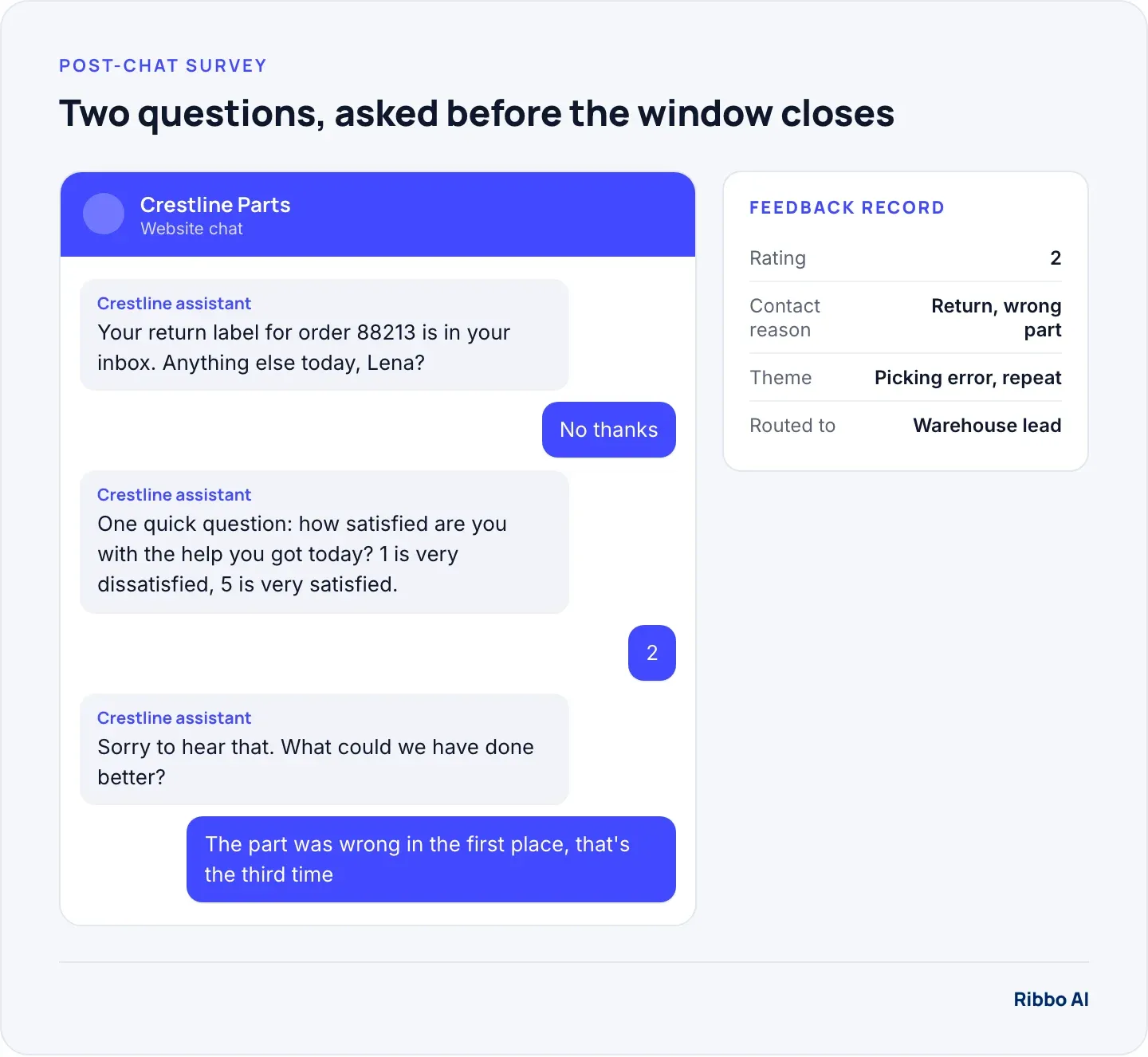
Save the rating with the context you already hold: contact reason, channel, whether the conversation was resolved by the AI agent or a person, and the agent's name. Without that, a pile of 2's cannot tell you whether the problem was the reply, the wait or the product.
Two more templates to copy
Order experience survey (1 to 3 days after delivery)
- How satisfied are you with your order overall? (1 very dissatisfied to 5 very satisfied)
- Did everything arrive as expected? (Yes / No, something was missing or damaged / No, it was late)
- What is one thing we could do better? (Optional, free text)
Relationship survey (twice a year)
- How likely are you to recommend us to a friend or colleague? (0 not at all likely to 10 extremely likely)
- What is the main reason for your score? (Free text)
- Which of these should we improve first? (Pick one from four or five options you are prepared to work on)
- May we contact you about your answers? (Yes / No)
Score the first question with the free NPS calculator, which shows the split between promoters, passives and detractors behind the number.
Acting on the results
Survey programmes fail at this step more often than at any other. Set up these four habits before the first survey goes out.
- Read every low score weekly. One named owner reads all 1s and 2s (or 0 to 6 on NPS) and tags each comment with a theme: delivery, wrong item, wait time, policy, product fault.
- Count the themes, then fix the top two. A theme that appears in 30 comments a month is a process problem. Give it an owner outside support if the cause is outside support.
- Reply to customers who scored low. A short message from a person, within a day, acknowledging the specific problem. Some of those conversations will recover a customer you were about to lose.
- Tell customers what changed. When a fix ships, a line in your next update ("you told us returns took too long, so refunds now go out the day the parcel is scanned") makes the next survey worth answering.
Where Ribbo fits
Ribbo AI answers customers on WhatsApp, web chat and email, and records every conversation with its outcome: resolved by the agent, resolved by the team, or still open. Its analytics show escalation reasons and the questions it could not answer, which often explain low survey scores before anyone reads the comments. Conversations that need a person, including a follow-up with an unhappy customer, go to your team with the full transcript. See the platform for how the pieces fit together.
Frequently asked questions
How many questions should a customer feedback survey have?
Two for a transactional survey: one rating and one open question about the reason. Up to five for a relationship survey, and only if you will act on every answer.
Should I offer an incentive for completing the survey?
A prize draw can raise response rates, and it also attracts people who answer for the prize. If you use one, keep it small and the same every time, and never tie it to the score given.
Is email or SMS better for feedback surveys?
Neither in general. Use the channel where the experience happened: in-chat for chats, SMS or WhatsApp for deliveries and appointments, and email for experiences that started there. Then keep the channel fixed so your trend stays comparable.
Should the AI agent ask the survey question?
It can, at the end of the conversation it handled, as long as the rating is stored with who resolved the conversation. That lets you compare satisfaction for conversations the agent finished with those your team finished.