
ChatGPT for customer service: what works and where it breaks | RibboAI

ChatGPT is a good writing assistant for a support team and a risky one to put in front of customers. Here is where it helps, where it fails, and what a customer-facing setup needs.
ChatGPT for customer service works well behind the counter and badly in front of it. Inside a support team it drafts replies, summarizes long threads and rewrites a blunt answer into a polite one, and it saves real time. Put the same model in front of customers on its own and it will answer questions about your prices, policies and stock that it has never seen, with complete confidence.
The gap is data. ChatGPT knows a great deal about the world and nothing about your business or the person writing to you. This guide covers where it helps today, where it breaks, and what a customer-facing setup needs before it goes live.
Three ways teams use ChatGPT for customer service
Most teams end up at one of three levels, and the risk rises with each one.
- A writing assistant for agents. Staff paste in a customer message and ask for a draft, a summary or a translation. A person reads and sends every reply.
- A document chatbot. A custom GPT or website widget that answers from a set of uploaded pages. Customers talk to it directly.
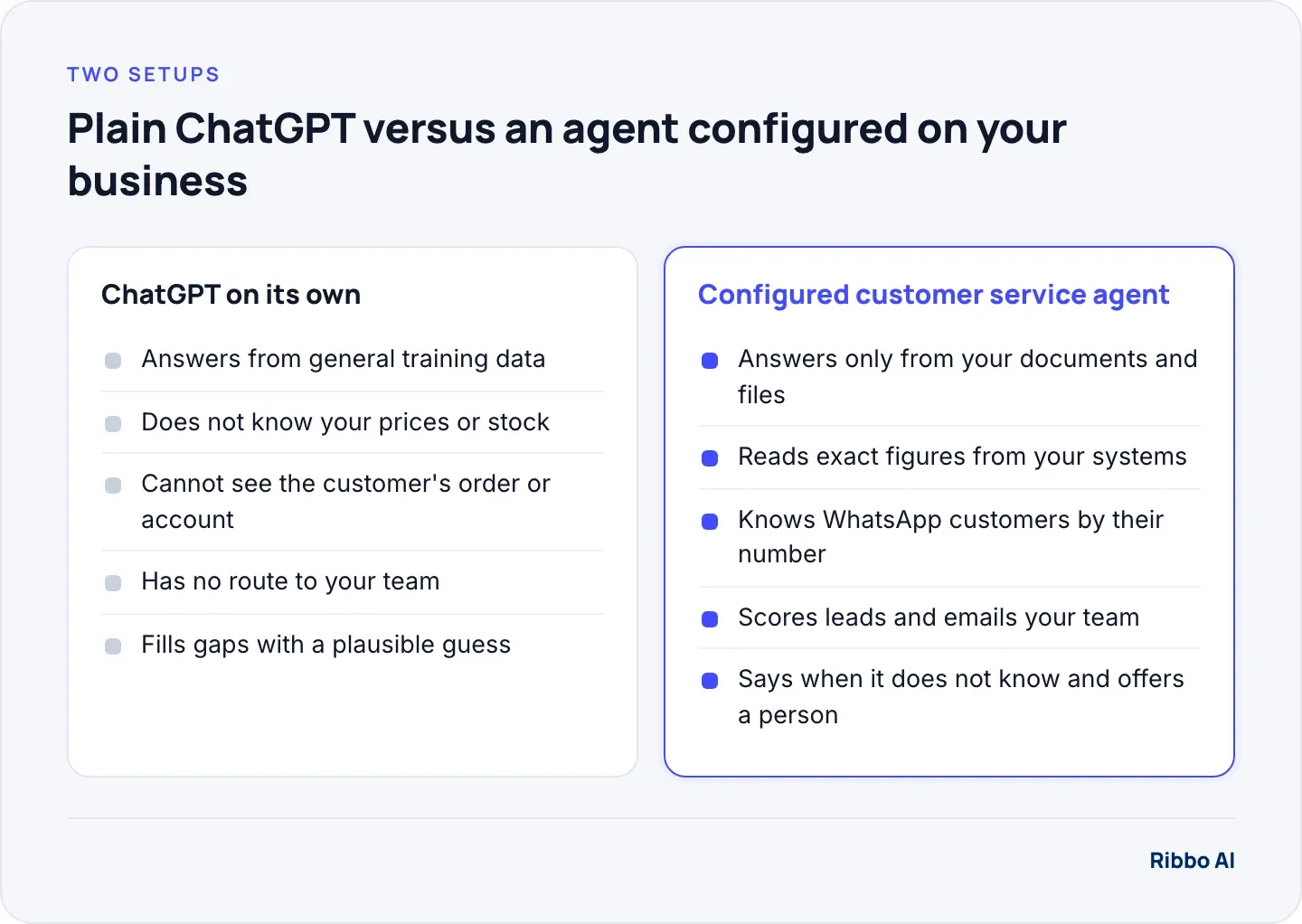
- A configured agent. The same kind of model, connected to your knowledge base and your systems, with rules about what it may say and when it must bring in a person.
Level one is safe almost everywhere. Level two is where most of the public failures happen. Level three is what an AI customer service agent such as Ribbo AI provides, and it is the only version that can answer "where is my order" with the actual order.
Where ChatGPT helps your support team today
These jobs need no integration and no customer-facing risk, because a person checks the output before it goes anywhere.
- First drafts of replies. Paste the customer's message and your policy paragraph and ask for a reply under 80 words. Editing a draft is faster than writing from nothing.
- Tone fixes. "Make this firmer but polite" turns a defensive refund refusal into something a customer can accept.
- Thread summaries. A 40-message escalation becomes five lines for the manager who has to approve a credit.
- Translation. A reasonable first pass for languages your team does not speak, checked by someone who does when the stakes are high.
- Macros and saved replies. Ask for ten versions of a delay apology and keep the two that sound like you. Our canned responses library is a quicker starting point if you would rather edit than generate.
A prompt that works for drafting looks like this:
Customer message: [paste]. Our policy: [paste the relevant paragraph]. Write a reply under 80 words. Use only the policy above. If the policy does not answer the question, say a colleague will follow up today.
The last instruction matters. Telling the model what to do when it lacks information is the habit that carries over to every later stage.
Where it breaks in front of customers
It invents prices and policies
A general model asked about your returns window will produce a returns window. It may be the industry norm, or it may be wrong. In February 2024 a British Columbia tribunal ordered Air Canada to compensate a passenger after its website chatbot said a bereavement fare could be claimed after travel, which the airline's real policy did not allow. The tribunal held the airline responsible for what its chatbot said, just as it would be for a static page, according to CBC News.
That chatbot had access to the airline's website. The failure came from answering beyond what the source said. A plain ChatGPT setup has even less to go on.
It knows nothing about the customer
"Where is order 4471?" and "what is my balance?" are among the most common support questions in retail and finance. ChatGPT cannot answer either, because the answer lives in a row in your system. A document chatbot cannot answer them reliably either: searching documents finds text that looks similar, which is useful for "how do refunds work" and useless for one customer's exact figure. Our explainer on retrieval-augmented generation covers why.
It cannot do anything
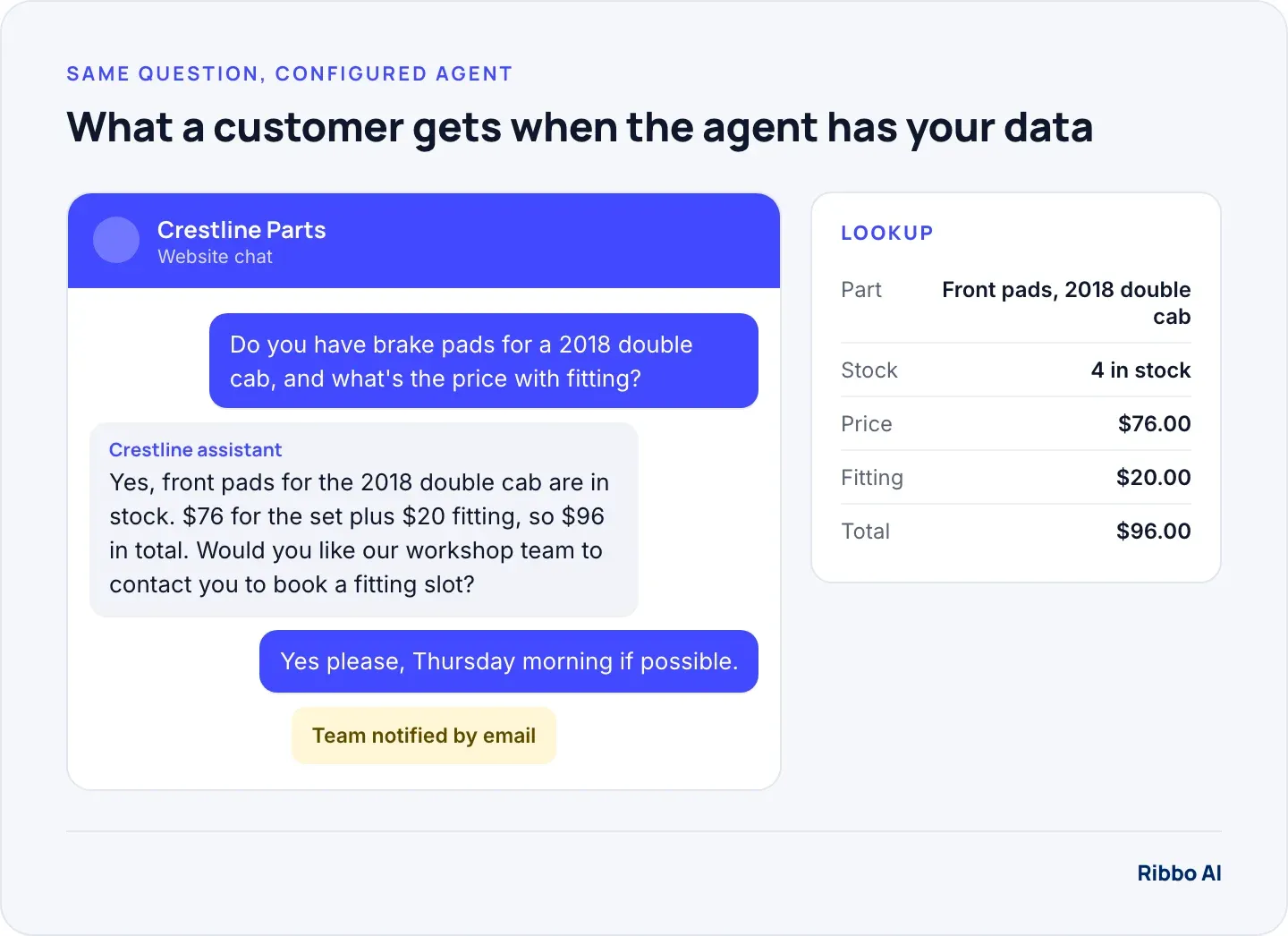
Customers rarely want general information. They want their own order, their own balance, the exact price for their car with fitting. A model with no connection to your systems can only describe where to find those things, which sends the customer off to look somewhere else.
It leaves no record and no handoff
When a conversation needs a person, the customer should not have to start again. A standalone chatbot has no route to your team and no record your sales or support staff can pick up.
What a customer-facing setup needs
Every item below closes one of the failures above. If a vendor or an internal build cannot show you each one working, it is not ready for customers.
- Answers grounded in your content. The agent replies only from your pages, price lists and policies, and nothing from its general training fills the gaps.
- Permission to say "I don't know". When the source does not cover a question, the agent says so and offers a person instead of hallucinating a response.
- Exact lookups for exact facts. Balances, order status and stock come from your system through a tool call, keyed on an order number or, on WhatsApp, the sender's phone number. Ribbo calls these Data Tools.
- Guardrails you configure. Never quote a price it cannot verify, never promise a refund, never discuss a competitor. See our guide to guardrails.
- A route to a person. When the customer asks for someone, or the question needs one, your team is told straight away and can read everything already said, so the customer does not repeat themselves.
- A record of every conversation. Every chat is kept where your team can read it, and buying conversations are flagged so sales can follow up.
What about customer data and privacy?
Two separate questions get mixed up here. The first is what happens when staff paste customer details into ChatGPT. OpenAI states that content from its business products, including ChatGPT Business, ChatGPT Enterprise and the API, is not used to train its models by default, per its enterprise privacy page. Individual ChatGPT accounts are different: OpenAI's data use policy says their content may be used to improve models unless the user turns that off. If your team uses personal accounts for work, fix that before anything else.
The second question is what a customer-facing agent may reveal. An agent that can look up accounts must verify who it is talking to first, and the identifier it uses should come from the verified session rather than from anything the customer types. Otherwise a cleverly worded message can ask for someone else's record.
How to start
The order matters more than the tool. Each step below gives you what you need for the next one.
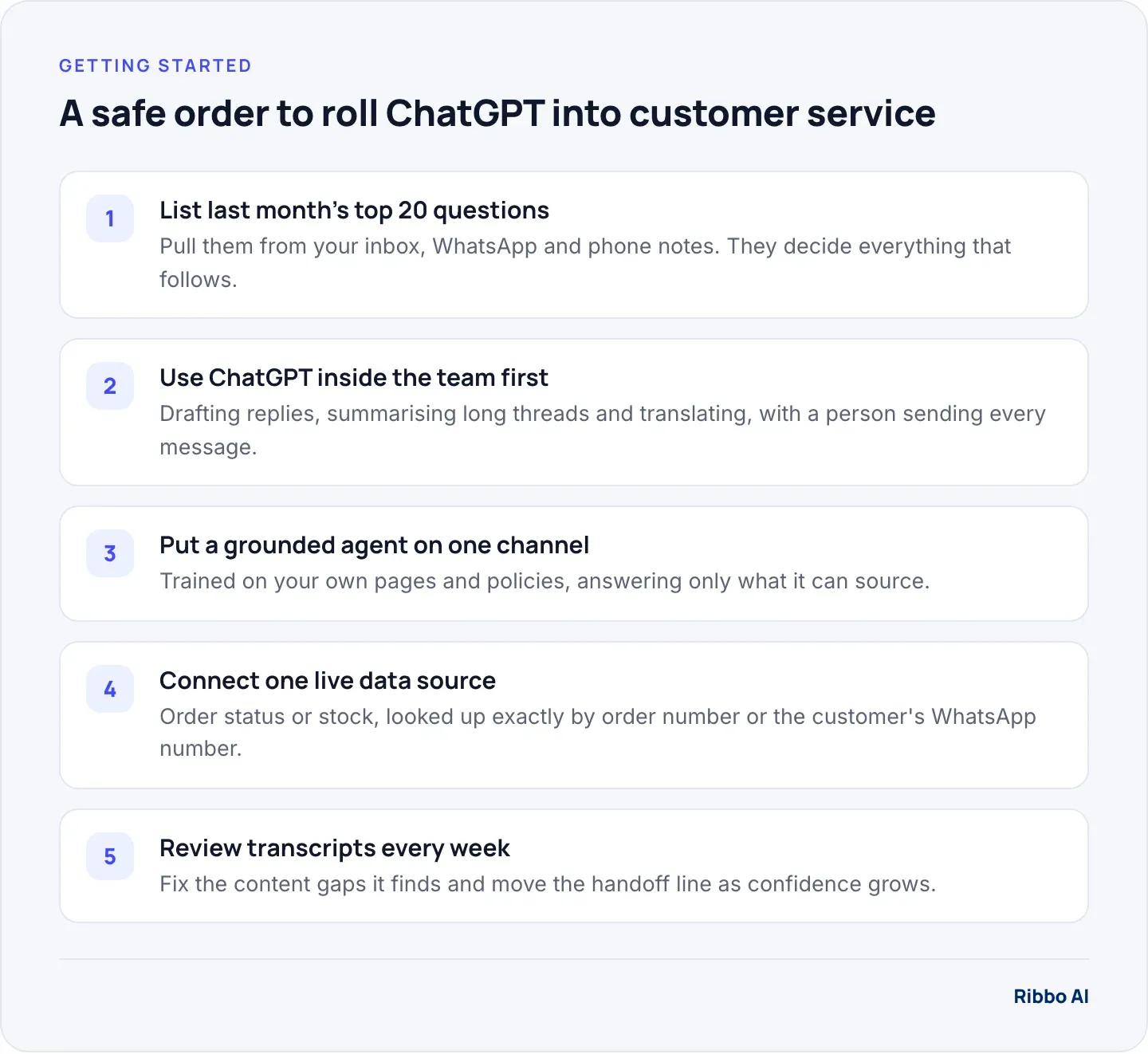
A small business can move through all five in a few weeks. A bank or insurer will spend longer on steps four and five, because verification, redaction and approval rules need sign-off from risk and compliance. Our AI readiness assessment scores where you are in ten questions.
Where Ribbo fits
Ribbo is the third level from the start of this guide. You give it your website, files and data, and it answers customers on your website, WhatsApp, Messenger and Instagram. It looks up exact records such as an order or a stock level through Data Tools, and on WhatsApp the sender's number identifies the customer. When a person is needed, your team gets an email and follows up, and every conversation is readable in the dashboard. You pick the model per agent from Anthropic, OpenAI or Google, and your conversations and content are not used to train shared models. You can start free and test it on your own questions before connecting a channel.
Frequently asked questions
Can I use ChatGPT for customer service for free?
For drafting replies inside your team, yes, with the privacy caveat above about personal accounts. Answering customers directly needs a setup grounded in your own content with a route to your team, which free ChatGPT does not provide. Ribbo has a free plan with 30 message credits for testing.
Can ChatGPT answer customers on WhatsApp?
Not on its own. A business needs the WhatsApp Business Platform connected to an agent that holds its content and rules. Our WhatsApp page explains how Ribbo runs on your own number.
Will ChatGPT replace my support team?
It changes the work more than the headcount. Repeated questions move to the agent, and people spend their time on exceptions, complaints and the sales conversations the agent passes to them. Teams that plan for that shift get more from it than teams that plan for cuts.
How do I stop an AI chatbot from making things up?
Limit it to your own sources, instruct it to answer only from them, let it say it does not know, and fetch exact figures through lookups rather than document search. Our glossary entry on hallucination goes into each fix.